
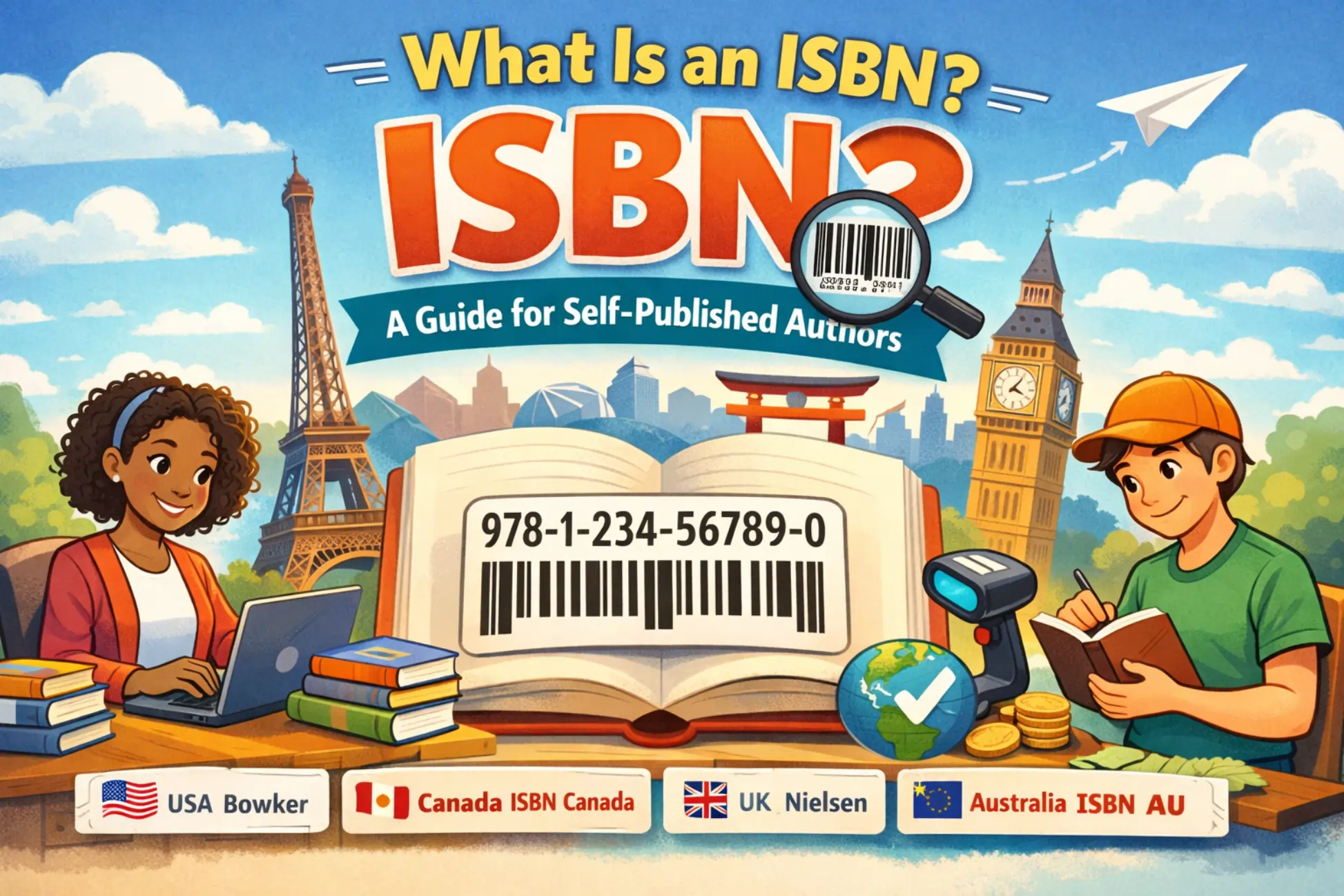
Updated for modern self‑publishing · Written by the Kidillus Publishing Team
When you first hear the word "ISBN," it sounds official and intimidating — like something only big publishers deal with. Then someone tells you to just grab a free one from Amazon, and suddenly it doesn't sound important at all.
Both reactions are understandable, and both are slightly off.
The truth is that ISBNs are simple once you know what they actually do. This guide explains everything in plain language — no jargon, no sales pitch — so you can make the right decision for your book and move forward with confidence.
What You'll Learn
By the end of this guide you'll understand what an ISBN is, who actually needs one, when the free option is perfectly fine, how ISBNs differ from barcodes, and where to get one in your country.
1. What Is an ISBN?
ISBN stands for International Standard Book Number. It is a 13‑digit code that uniquely identifies one specific book in one specific format.
Think of it as your book's official ID card.
Two books can share the same title, the same author name, even the same cover design — but no two books in the world share the same ISBN. That uniqueness is what allows bookstores, libraries, online retailers, and distributors to find and order the exact book a customer wants, without confusion.
Three things an ISBN does not do:
- It does not give you copyright protection
- It does not prove you own the content
- It does not make your book more discoverable on its own
Copyright and ISBNs are entirely separate systems. You own your writing the moment you write it, whether or not you ever assign it an ISBN.
2. Why Does the Publishing Industry Use ISBNs?
When millions of books are bought and sold globally every day, the industry needs a reliable way to tell them apart. ISBNs solve that problem.
They allow a bookstore in the UK to order the exact paperback edition you published — not a different edition, not a competitor's book with a similar title — just yours. Libraries use ISBNs to catalog titles accurately. Wholesalers use them to manage inventory. Point‑of‑sale systems use them to scan and process sales instantly.
Without ISBNs, the global book supply chain would require far more human checking and would produce far more errors.
3. How Many Digits Does an ISBN Have?
All modern ISBNs have 13 digits.
Before 2007, ISBNs were only 10 digits long. As the publishing industry grew, the pool of available numbers began running low, so a 3‑digit prefix — either 978 or 979 — was added to create the current ISBN‑13 standard.
If you come across an older 10‑digit ISBN on a legacy book, it is simply an earlier format. The current global standard is ISBN‑13, and that is what all new publishers assign today.
4. Who Actually Needs an ISBN?
Every printed book needs an ISBN. This applies to paperbacks, hardcovers, large‑print editions, and any other physical format you intend to sell or distribute through a retailer, wholesaler, or library.
Digital books are a different story. Most major ebook platforms — including Amazon Kindle Direct Publishing, Apple Books, Kobo, Google Play Books, and Barnes & Noble Press — do not require an ISBN for ebook distribution. They issue their own internal identifiers (Amazon uses an ASIN, for example). If you are publishing an ebook only, you can skip the ISBN entirely and lose nothing.
5. Should Self‑Published Authors Buy Their Own ISBN?
This is the question most first‑time authors wrestle with, and the answer depends on your goals.
Option 1 — Free ISBNs from Platforms
Amazon KDP, Draft2Digital, BookBaby, and similar services offer free ISBNs to authors who publish through them.
The catch: when you use a platform's free ISBN, the platform is listed as the publisher of record in global databases. Your name or imprint does not appear in that field. You also cannot transfer a platform‑issued ISBN to a different printer or distributor — it is tied to that platform.
For many authors, this is not a practical problem. If you plan to sell primarily through Amazon and have no plans to approach brick‑and‑mortar bookstores, a free ISBN works fine.
Option 2 — Buying Your Own ISBN
When you purchase your own ISBN through your country's official ISBN agency, you are listed as the publisher. You can use that ISBN with any printer, on any platform, with any distributor — it belongs to your book permanently.
The main reasons authors buy their own ISBNs are control, professional branding, and distribution flexibility. If you are building a publishing imprint, planning to approach bookstores or libraries, or distributing through multiple channels at once, owning your ISBNs is the cleaner long‑term choice.
The honest answer: for an author focused on online sales — ebooks, Amazon print‑on‑demand, Etsy — a free ISBN is perfectly acceptable. Buying an ISBN does not improve royalties, increase visibility, or change the quality of your book.
6. When Buying Your Own ISBN Makes Clear Sense
Consider purchasing your own ISBN if any of these apply to you:
- You want to sell in physical bookstores or get library stocking
- You want your own name or publishing imprint listed as the publisher
- You plan to distribute across multiple platforms and printers simultaneously
- You are building a long‑term publishing brand with multiple titles
If none of those apply right now, start with the free option and upgrade later if your plans change. ISBNs are assigned per edition — switching printers or distributors in the future simply means getting a new ISBN for the new edition.
7. Does Every Format Need a Separate ISBN?
Yes — each format of your book requires its own ISBN. This is one of the most commonly misunderstood rules.
Your paperback, your hardcover, your ebook (if you choose to assign one), your large‑print edition, and any revised or updated edition each need a different ISBN. They are treated as distinct products.
A simple reprint of the same format with no content changes does not require a new ISBN — you reuse the existing one.
8. Can an ISBN Be Reused or Transferred?
No, and this is absolute. An ISBN is permanently assigned to one specific edition of one specific book. Once it is used, it cannot be reassigned, reused, or transferred to a different title or a different edition. If you revise your book significantly, you need a new ISBN.
9. Where to Get an ISBN in Your Country
ISBNs are issued by official national agencies, all coordinated by the International ISBN Agency. Always use your country's official agency — never a random third‑party seller online.
United States Agency: Bowker — myidentifiers.com
Australia Agency: Thorpe‑Bowker — thorpe.com.au
United Kingdom & Ireland Agency: Nielsen — nielsenisbnstore.com
Canada ⭐ Free Agency: Library and Archives Canada — bac‑lac.gc.ca
India Agency: Raja Rammohun Roy National Agency — isbn.gov.in
Germany Agency: MVB — german‑isbn.de
France Agency: AFNIL — afnil.org
South Africa Agency: National Library of South Africa — isbn.nlsa.ac.za
New Zealand Agency: National Library of New Zealand — natlib.govt.nz
10. ISBNs vs. Barcodes — What Is the Difference?
These two things are often confused because they appear together on the back of every printed book.
An ISBN is a number. It is printed in human‑readable digits on the copyright page and on the back cover.
A barcode is a scannable image that represents that same number in a format machines can read at the point of sale. The standard format for books is called EAN‑13.
Every printed book needs both — the ISBN for identification in databases, and the barcode so retailers can scan it at checkout.
Once you have your ISBN, generating the barcode is straightforward. Kidillus provides a free ISBN barcode generator that converts your 13‑digit ISBN into a print‑ready PDF, SVG, or PNG file — no account required.
11. What Do the Numbers Inside an ISBN Mean?
Every ISBN‑13 is divided into five parts, each separated by a hyphen:
978‑0‑306‑40615‑7 breaks down as:
- 978 — the prefix (part of the EAN/UCC system)
- 0 — registration group (language or country)
- 306 — publisher identifier
- 40615 — title and edition identifier
- 7 — check digit, used to verify the number is valid
When you enter an ISBN into our barcode generator, the check digit is automatically verified before the barcode is drawn — which is why an invalid ISBN will produce an error rather than a flawed barcode.
Final Thoughts
ISBNs are one of those topics that sound complicated from the outside but turn out to be quite logical once you see how they fit together.
If you take nothing else from this guide, remember these three points:
- Printed books need ISBNs. Ebooks generally do not.
- Each format needs its own ISBN. Paperback and hardcover are separate.
- Free ISBNs are perfectly valid — the difference is about publisher branding and distribution control, not quality.
Once your ISBN is sorted, the next steps are cover design, interior formatting, and uploading your files — and that is exactly where Kidillus helps authors turn manuscripts into professional, market‑ready books.
Happy publishing. 🚀
Related tools from Kidillus:
- Free ISBN Barcode Generator — convert your ISBN to a print‑ready barcode
- KDP Cover Calculator — get exact cover dimensions for your book
- KDP Description HTML Formatter — format your Amazon book description correctly