
You’ve spent months (or years) perfecting your manuscript. You’ve partnered with Kidillus to create breathtaking illustrations. Now comes the technical fork in the road: What is the trim size of your book?
Many authors think trim size is just about the physical dimensions of the book. But at Kidillus, we see it differently. To us, the trim size is the frame of your masterpiece. Picking the wrong size can make a stunning illustration look cramped or leave awkward empty spaces.
1. Why Your Illustrator Needs a Trim Size Before Starting
In the world of art, "Aspect Ratio" is everything. If we draw a sprawling, wide-angle landscape for a 10" x 8" (Landscape) book, and you later decide to switch to a 8.5" x 8.5" (Square) size, the edges of that beautiful art will be "cropped" or cut off.
Before we pick up the stylus, we need to know:
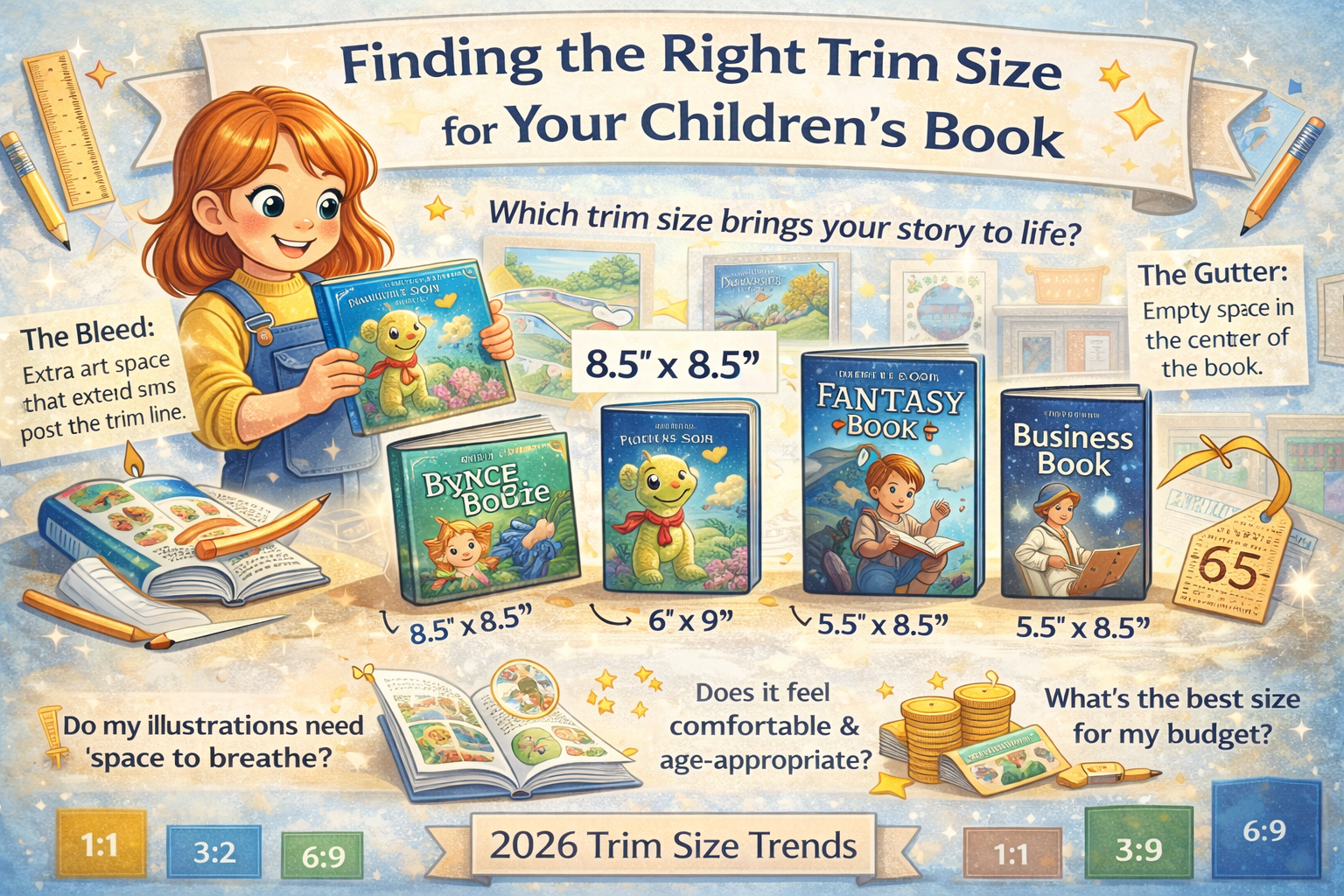
- The Bleed: The extra space where the art extends beyond the trim line so there are no white edges.
- The Gutter: The "dead zone" in the middle of the book where the pages are glued. If your trim size is too small, your character’s face might disappear into the fold!
2. 2026 Trends: The Most Popular Trim Sizes for Visual Books
Based on current market data and publisher preferences, here are the "gold standard" sizes for 2026:
Genre Recommended Trim Size The Visual Impact
Children’s Picture Books 8.5" x 8.5" or 10" x 8" Provides a cinematic "widescreen" feel for big, bright characters.
Graphic Novels / Memoirs 6" x 9" or 6.625" x 10.25" The industry standard for panel-based storytelling and complex art.
Business & Self-Help 5.5" x 8.5" Clean, professional, and perfect for infographics and icons.
YA Fantasy & Sci-Fi 6" x 9" Large enough to include detailed maps and decorative chapter headers.3. Questions to Ask Yourself Before Deciding
3. Questions to Ask Yourself Before Deciding
Don't just pick a size because your favorite book uses it. Ask yourself:
- Does my art need to "Breathe"? Detailed, intricate illustrations often need larger trim sizes (like 7" x 10") to be appreciated.
- What is the "Hand-Feel"? A children’s book needs to be easy for a child to hold, while a coffee table book should feel substantial and heavy.
- What is the Print Cost? Standard sizes (like 6x9 or 8.5x8.5) are usually more budget-friendly at printers like IngramSpark or KDP.
4. The Kidillus "Pro-Tip"
If you are undecided, we always recommend going with a standard industry size. Custom sizes can be expensive to print. Also, communicate with us early! It is much easier to plan a layout correctly from the start than to stretch or squeeze art later.
Conclusion
Your book’s size is the first thing a reader feels before they even see the first word. Make sure it complements your vision, not complicates it.
Are you ready to bring your story to life? At Kidillus, we don't just draw; we help you design the entire visual experience—from the first sketch to the final trim. Get a Quote Today.