
You’ve finally done it. You’ve written the manuscript, polished the rhymes, and maybe even hit "publish" on Amazon KDP. But weeks have passed, and the sales numbers aren’t moving.
Why?
The children’s book market is one of the most competitive industries in the world. According to recent data, thousands of self-published books go live every single day. In this crowded ocean, a great story isn’t enough. You need a brand.
As a professional children’s book illustrator with over 10 years of experience (and a web developer who understands the digital landscape), I’ve seen great stories fail simply because the presentation wasn’t right.
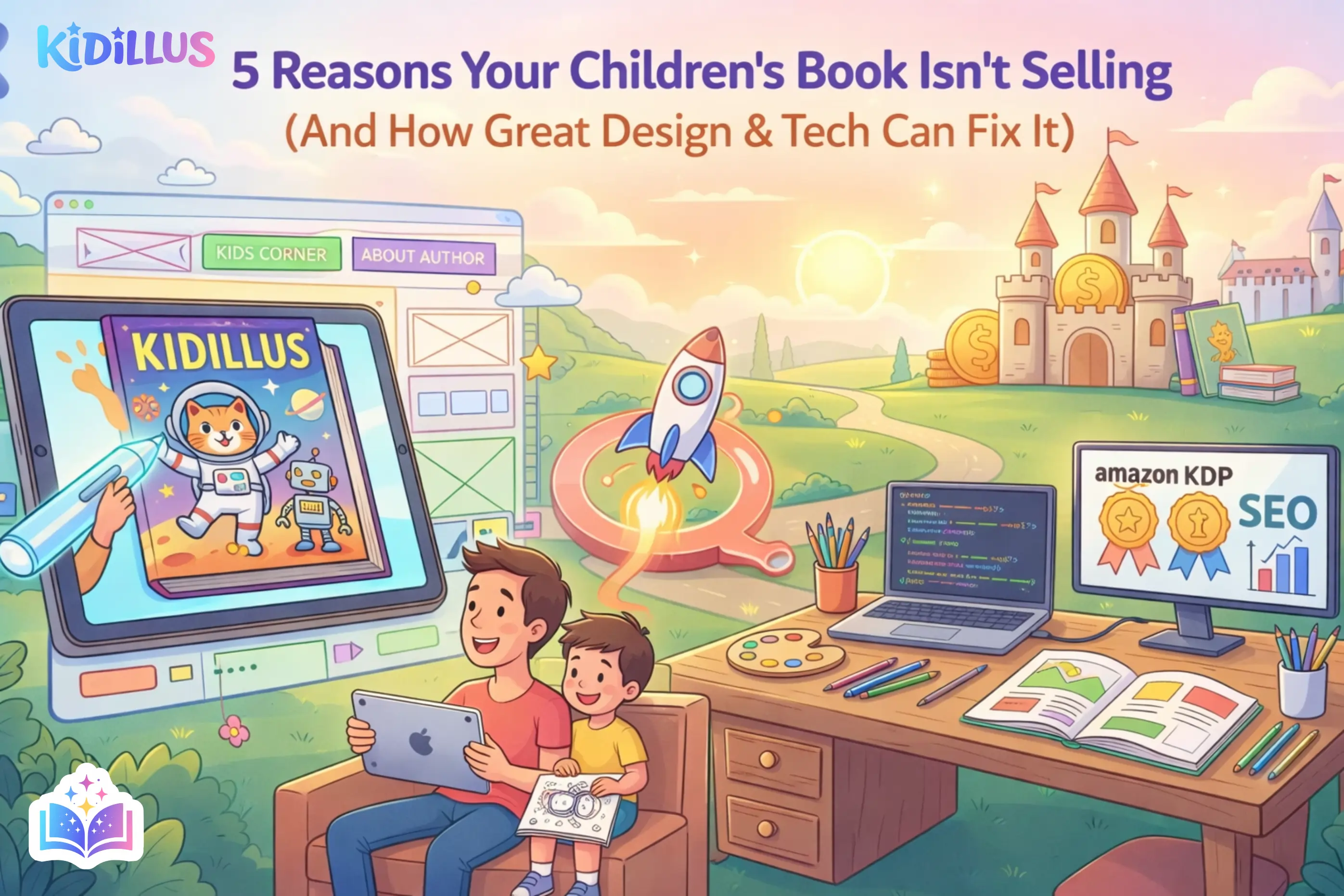
Here are the top 5 reasons your book might be invisible to readers—and exactly how to fix them using professional illustration and a smart website strategy.
1. Your Cover Doesn't "Pop" at Thumbnail Size
When parents browse Amazon or a library website, they aren’t looking at your book in real life; they are looking at a tiny, 1-inch image on their phone screen.
The Mistake: Many authors try to cram too much detail into the cover. Complex paintings look beautiful on a wall, but they look like a muddy blur on an iPhone screen.
The Solution: Flat Color & Bold Composition This is where professional Flat Color Illustration shines. This style uses clean lines, bold shapes, and vibrant, solid colors. It is specifically designed to be readable at any size.
· Action Step: Look at your book cover on your phone. Can you tell what the main character is doing in less than 2 seconds? If not, it’s time for a redesign. A professional illustrator knows how to use "visual hierarchy" to guide the buyer’s eye instantly.
2. You Are Relying on Social Media Instead of a Website
"I have an Instagram page, why do I need a website?"
I hear this question all the time. Here is the hard truth: You don’t own your Instagram followers; the algorithm does. If Instagram changes its rules tomorrow, your business disappears.
The Mistake: Sending potential buyers to a social media profile where they get distracted by other posts, ads, and notifications.
The Solution: A Dedicated Author Website Your website is your digital home. It is the only place on the internet where you have 100% control over the narrative. A professional author website needs to do three things:
1. Capture Emails: Build a newsletter list so you can sell your next book directly to fans.
2. Showcase Credibility: A sleek, fast-loading site proves you are a professional, not a hobbyist.
3. Sell Direct: Link directly to Amazon, Barnes & Noble, or sell signed copies yourself.
3. Your "World" Doesn't Feel Immersive
Children’s books are about magic and immersion. When a child loves a book, they want to live in that world.
The Mistake: Having a website that looks like a corporate blog. White background, standard Times New Roman text, and a generic contact form. This breaks the magic.
The Solution: Interactive Design Your website should feel like an extension of your book.
· Visual Continuity: If your book uses soft pastels and cute animals, your website header should feature those same characters greeting the visitor.
· The "Fun" Factor: As a developer, I always recommend adding a "Kids' Corner" to author sites. This can include downloadable coloring pages (which I can illustrate for you) or simple puzzles.
· Why it works: Parents love free activities. If they download a coloring sheet from your site, they are 50% more likely to remember your name and buy your book.
4. Your Book Formatting Looks "Amateur"
There is a technical side to illustration that many new authors ignore: Bleed, Trim, and CMYK.
The Mistake: You hired a cheap artist who gave you RGB images (meant for screens). When you printed them via KDP or IngramSpark, the colors came out dull, or worse, important parts of the image were cut off because the "bleed" settings were wrong.
The Solution: Hire a Technical Expert An illustrator isn’t just someone who can draw; they must understand print production.
· CMYK vs. RGB: A pro ensures your bright reds and blues print exactly as vibrant as they look on screen.
· Typography: The placement of text is an art form. It needs to flow with the illustration, not just sit on top of it.
5. You Aren't optimizing for "Search" (SEO)
You might have the best book about "Potty Training for Toddlers," but if no one can find it on Google, it doesn't exist.
The Mistake: Naming your website pages "Page 1" or "Home."
The Solution: SEO (Search Engine Optimization) This is where my web development background comes in. Your website needs to be built with clean code (like PHP/HTML) that Google can read easily.
· Keywords: Your blog posts and page titles should answer questions parents are asking, like "Best bedtime stories for 5-year-olds" or "Books to help kids deal with anxiety."
· Speed: Parents are busy. If your mobile site takes more than 3 seconds to load, they will click away. A custom-optimized site is always faster than a heavy, drag-and-drop template.
Conclusion: You Don't Have to Do It Alone
Writing the story was your job. Bringing it to life—both on paper and on the screen—is mine.
To succeed in 2026, you need to think of yourself as a media company, not just a writer. You need illustrations that pop, a website that converts, and a technical foundation that ensures everything runs smoothly.
Are you ready to give your children’s book the professional launch it deserves?
Whether you need a whimsical cover design, a full 32-page illustration package, or a high-performance author website to sell your work, I am here to help.
[Contact Me Today for a Free Consultation]
Let’s build your world, together.