
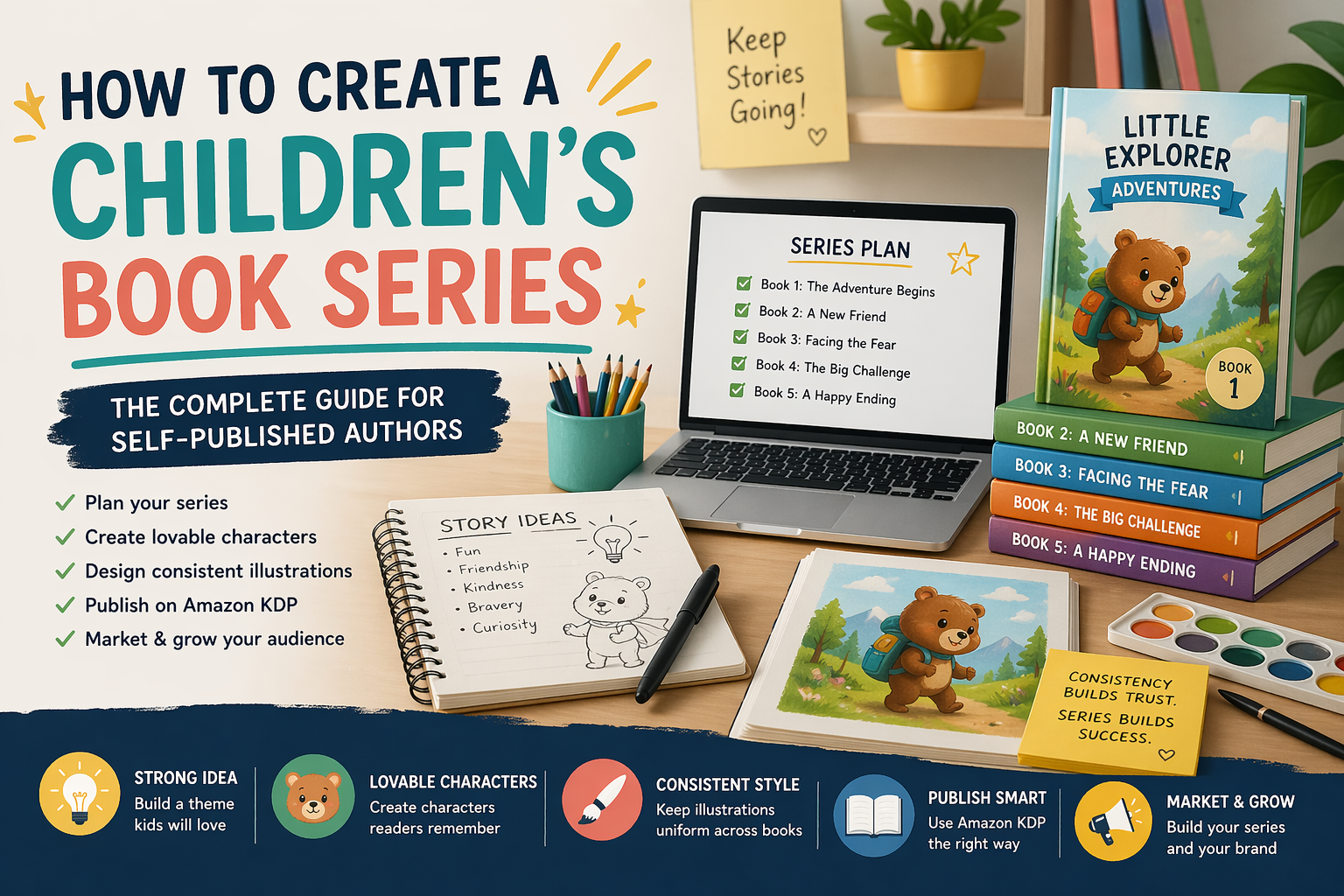
If you've already written one children's book — congratulations! You've done something most people only dream about. But here's what the most successful self-published authors know: a single book is a good start. A series is a business.
A children's book series builds loyal readers, grows your Amazon presence, and multiplies your income without starting from scratch every time. In this complete guide, we'll walk you through exactly how to plan, create, and launch a children's book series — from your very first idea to your fifth title on the shelf.
Why Create a Children's Book Series?
Before we dive into the "how," let's talk about the "why." Many first-time authors treat their book as a one-time project. But experienced self-publishers know that a series changes everything.
Here's why a series beats a standalone book every time:
- Built-in audience. Readers who loved Book 1 will automatically look for Book 2. You don't have to win them over again.
- Better Amazon rankings. Amazon's algorithm favors authors with multiple books. More titles means more chances to appear in search results.
- Higher royalties per reader. A reader who buys all 5 books in your series spends 5x more than someone who buys just one.
- Stronger brand. A recognizable series name, character, or theme makes marketing far easier.
- Illustration consistency. Working with the same illustrator across multiple books saves time, money, and keeps your visual style consistent.
The bottom line? A series gives you compounding returns. Each new book makes all your previous books sell better.
Step 1: Choose the Right Type of Series
Not all children's book series work the same way. Before you write a single word, decide what kind of series you want to create.
A) Character-Based Series
The most popular format. One main character appears in every book, going on different adventures each time.
Examples of this format:
- The same bunny learns about sharing in Book 1, makes a new friend in Book 2, and faces a fear in Book 3.
- Each book is a standalone story, but readers fall in love with the character and want more.
Best for: Picture books, ages 3–8.
Why it works: Children attach emotionally to characters. When they love a character, they want to follow that character through new adventures.
B) Theme-Based Series
Each book in the series explores a different aspect of the same theme — emotions, values, animals, or places.
Examples of this format:
- A "Feelings" series with one book about anger, one about sadness, one about excitement.
- A "World Animals" series where each book features a different animal from a different country.
Best for: Educational books, ages 4–9.
Why it works: Parents, teachers, and librarians buy the entire set because each book covers something new while staying in a familiar world.
C) Progressive Learning Series
Each book builds on the last — more complex vocabulary, longer stories, or harder concepts.
Examples of this format:
- Book 1 covers basic emotions; Book 2 covers handling those emotions; Book 3 covers helping others with their emotions.
- A reading-level series where Book 1 is for early readers and Book 5 is for confident readers.
Best for: Educational and early reader books.
Why it works: Parents buy the whole series because each book grows with the child.
D) Anthology / World-Building Series
A shared universe or setting where different characters appear in different books, but the world is the same.
Best for: Middle-grade and chapter books.
Step 2: Plan Your Series Before You Write Book 1
This is the mistake most first-time series authors make: they write Book 1 without thinking about Books 2 through 5. Then they get stuck.
Plan at least 3–5 books before you publish your first one. Here's how:
Create a Series Bible
A "series bible" is your private planning document. It contains:
- Your main character's full personality — name, age, quirks, fears, strengths, appearance
- The world your character lives in — town, home, family, friends
- The overarching theme — what does this series teach or celebrate?
- Book outlines — a one-paragraph summary for each book you plan to create
- Rules of your world — things that stay consistent across all books
Even if you never share this document with anyone, it keeps your series consistent and helps your illustrator stay on the same page.
Name Your Series Early
Your series name goes on every book cover, Amazon listing, and marketing material. Choose it carefully.
Tips for a great series name:
- Keep it short and memorable (2–4 words)
- Include the character's name if possible ("The Adventures of ___")
- Make sure it's unique — search Amazon before you finalize it
- Make sure it works for at least 5 books
Map Out Your Story Arcs
For each book, answer these questions:
- What is the main problem or adventure in this book?
- What does the main character learn or overcome?
- How is this book different from the others in the series?
- What keeps a reader wanting to come back for the next book?
Step 3: Create Consistent Characters and Illustration Style
In a children's book series, consistency is everything. Children need to instantly recognize your character from book to book. This means your illustration style, character design, and color palette should stay the same across the entire series.
Work With the Same Illustrator
The single most important decision you'll make for your series is choosing a skilled illustrator — and sticking with them.
Here's why: if you use a different illustrator for Book 2, your character will look different. Children will notice. Parents will notice. It breaks the magic of the series.
When hiring an illustrator for a series:
- Discuss the full series upfront. Many illustrators offer discounts for series commitments.
- Get a detailed character sheet. Before illustrations begin, have your illustrator create a character reference sheet — front view, side view, and expressions. This becomes the "master guide" for every book.
- Agree on a consistent color palette. Your series should have a recognizable look. Define 4–6 core colors that appear in every book.
- Discuss the illustration style. Watercolor? 3D? Flat digital? Cartoon? Choose a style and stick to it.
At Kidillus, we work with authors from Book 1 all the way through their entire series. Because our illustrators keep all character reference sheets and design files on file, moving from Book 1 to Book 5 is seamless — and significantly faster than starting fresh each time.
Design a Recognizable Cover Style
Every book in your series should have a visually consistent cover — same font style, similar layout, same color scheme. Think about any successful book series you know. You can tell at a glance that the books belong together.
Elements to keep consistent across all covers:
- Font family and title placement
- Author name position and style
- Border or frame style (if any)
- Color palette
- Character placement (usually centered or slightly left)
Step 4: Write Each Book with the Series in Mind
Now comes the writing. Even though each book should work as a standalone story, it should also feel like part of something bigger.
Every Book Should Stand Alone
A reader who picks up Book 3 without reading Books 1 or 2 should still understand and enjoy the story completely. Don't rely on the reader knowing backstory from previous books.
Every Book Should Make Readers Want More
At the end of each book, leave your reader satisfied — but curious. This doesn't mean a cliffhanger (that's generally not appropriate for young children). Instead:
- Introduce a new character at the end who will appear in the next book
- Have your main character mention something they want to try next time
- End with a question that naturally leads to the next adventure
Keep Word Count and Page Count Consistent
Readers and parents expect consistency in a series. If Book 1 is 32 pages with 500 words, Book 2 should be similar. Sudden changes in length and format feel jarring and unprofessional.
Standard page counts by category:
- Picture books (ages 3–7): 32 pages
- Early readers (ages 5–8): 48–64 pages
- Chapter books (ages 6–10): 80–120 pages
Step 5: Format Every Book Identically
Professional formatting is what separates self-published books that look homemade from ones that look like they came from a major publisher.
For a series, formatting consistency is non-negotiable:
- Same trim size across every book (8.5 x 8.5 inches is popular for picture books)
- Same font for body text and headings
- Same margin and bleed settings (KDP has specific requirements — follow them precisely)
- Same interior layout style — where text appears relative to illustrations
If you're formatting for Amazon KDP, make sure every file in your series meets KDP's full-bleed color formatting guidelines. A small error in one book can delay your entire launch.
At Kidillus, our formatting team creates a formatting template from Book 1 and applies it consistently to every subsequent book in your series — saving you significant time and ensuring a uniform look.
Step 6: Publish Strategically on Amazon KDP
Publishing a series on Amazon requires a different strategy than publishing a standalone book. Here's how to maximize your visibility:
Use Amazon's Series Feature
Amazon allows you to group your books into an official series. When you publish each book:
- Go to your KDP dashboard
- Under "Series," enter your series name and book number
- This creates a series page on Amazon where all your books appear together
This is powerful because when a reader finds any one of your books, they can immediately see and buy the rest.
Publish Books 1 and 2 Close Together
The biggest mistake series authors make is publishing Book 1 and then waiting 18 months for Book 2. By then, the momentum is gone.
Ideal publishing timeline:
- Publish Book 1
- Have Book 2 ready within 3–6 months
- Aim to publish a new book every 6–9 months after that
Price Book 1 Strategically
Many successful series authors price Book 1 lower — or even make the eBook version free or $0.99 — to attract new readers. Once readers love Book 1, they'll happily pay full price for Books 2 through 5.
Use KDP A+ Content for Every Book
A+ Content lets you add extra images and text below your book description on Amazon. For a series, use this space to showcase all the other books in the series. This is one of the most effective ways to drive readers from one book to the next.
Step 7: Market Your Series Like a Pro
A great series still needs marketing. Here's what works best for children's book series authors in 2026:
Build a Series Website or Landing Page
Even a simple one-page website that lists all your books, shows the covers, and links to Amazon makes a huge difference. It gives you a place to send people and builds credibility.
Create a Series-Specific Social Media Presence
If your main character is memorable, give them a social media presence. Post illustrations, behind-the-scenes sketches, and fun facts about the character. Parents and children love following fictional characters.
Use Pinterest for Long-Term Traffic
Pinterest is a massive, underused platform for children's book authors. Pin your book covers, illustration previews, and blog content. Pinterest pins stay active for months and years — unlike Instagram posts that disappear in 24 hours.
Reach Out to Schools and Libraries
Children's book series are ideal for school and library purchases. A librarian who buys one book often buys the whole series. Reach out directly to local schools and libraries with a press kit about your series.
Collect Email Addresses
Offer something free — a coloring page of your main character, a printable activity sheet, or a free preview of your next book — in exchange for email addresses. Your email list is your most valuable marketing asset for future book launches.
Common Mistakes to Avoid When Creating a Children's Book Series
1. Not planning ahead Writing Book 1 without a plan for Books 2–5 leaves you with an inconsistent series. Plan the series before you publish anything.
2. Changing illustrators mid-series This is one of the most damaging mistakes. Your character's appearance will change, breaking the visual consistency that readers expect. Commit to one illustrator for the whole series.
3. Waiting too long between books Reader momentum fades fast. If you wait 2 years between books, you'll have to rebuild your audience from scratch. Aim for a new book every 6–9 months.
4. Making each book too dependent on the previous one Every book in your series must be enjoyable on its own. Don't assume every reader has read previous books.
5. Ignoring Amazon's series feature If you don't link your books as a series on KDP, readers won't discover your other books easily. Always set up your series properly in your KDP dashboard.
6. Inconsistent covers If your covers look like they belong to different books from different authors, no one will recognize them as a series. Invest in a consistent cover design from the very beginning.
How Kidillus Helps Authors Create Entire Book Series
At Kidillus, we've helped over 1,000 authors publish their children's books — and we understand that a series is a long-term commitment that requires long-term support.
When you work with us for your series, here's what you get:
- Character reference sheets saved permanently so your character looks identical from Book 1 to Book 10
- Series illustration packages at discounted rates for authors committing to multiple books
- Consistent formatting applied across every book in your series, using templates built from your first book
- KDP-ready files for every title, formatted correctly for print, hardcover, and eBook
- Cover design continuity — our designers keep your series branding files and apply them to every new cover
Starting a series is one of the best decisions you can make as a children's book author. And having the right team behind you from Book 1 makes the journey significantly easier — and more profitable.
Final Thoughts: Your Series Starts with One Great Book
Creating a children's book series is one of the most rewarding things an author can do. It builds something real — a world, a character, a brand — that grows with every book you add.
Start with a strong plan. Choose a format that fits your story. Work with consistent, professional illustrators. Publish regularly. And market your series as a series, not just a collection of individual books.
The most successful children's book series didn't happen by accident. They were planned, crafted, and built with intention — one book at a time.
Ready to start your series? Get a free illustration quote from Kidillus and let's bring your first book — and your entire series — to life.
By Kidillus | Self Publishing | April 2026