
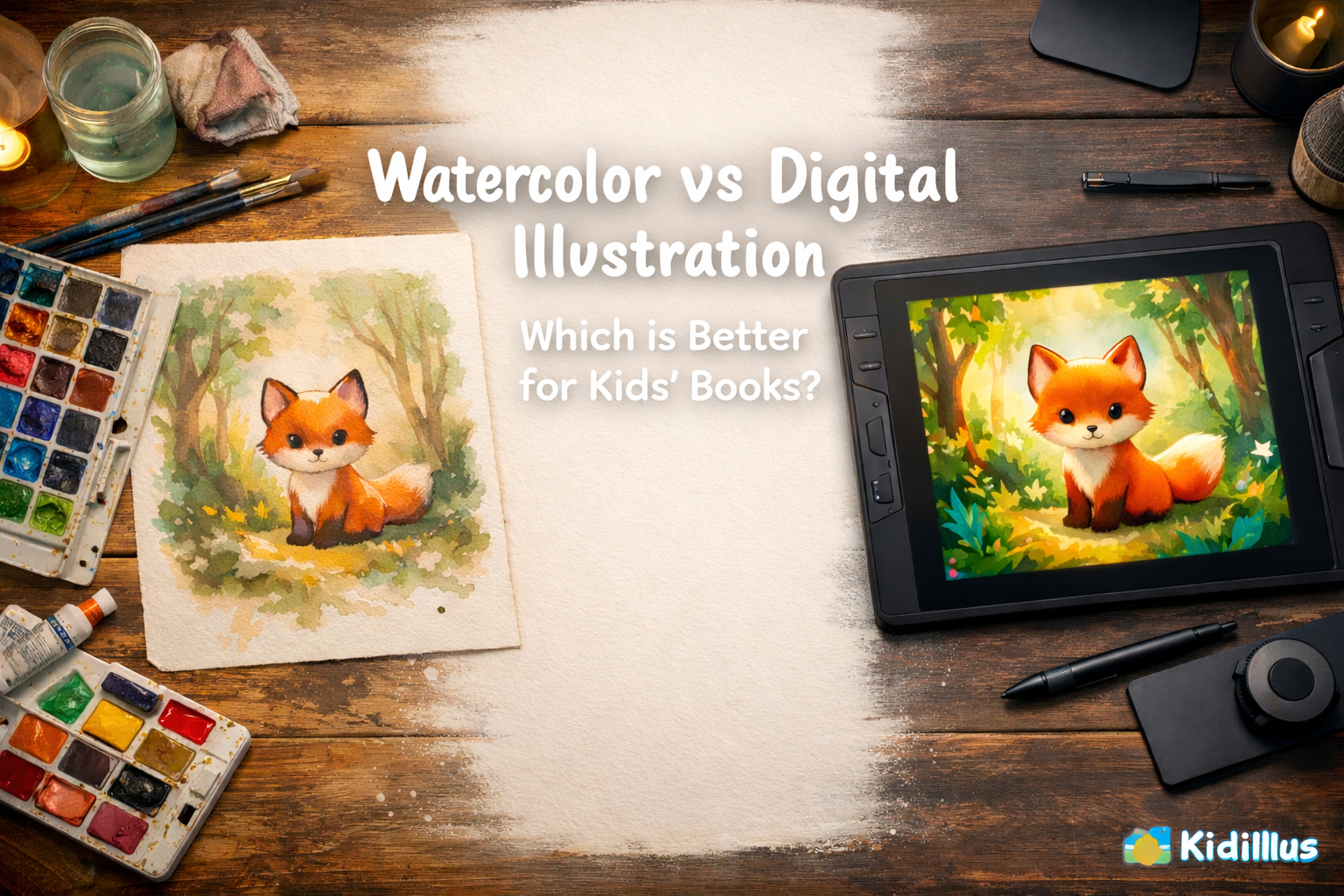
So you've written your children's book — congratulations! Now comes one of the biggest decisions every author faces:
Should I choose watercolor or digital illustration?
It sounds simple, but this one choice shapes everything — the mood of your story, how it prints, how fast it gets done, how much it costs, and how young readers will feel when they open the first page.
The good news? There's no wrong answer. But there is a right answer for your specific book.
In this guide, we'll walk you through everything — the real differences, the pros and cons, the printing considerations, the costs, and exactly which style fits which kind of story. By the end, you'll know exactly what to tell your illustrator.
Let's dive in.
What Is Watercolor Illustration?
Watercolor illustration is exactly what it sounds like — artwork painted by hand using watercolor paints on real paper, with real brushes.
The magic of watercolor lies in what you can't fully control. Paint bleeds into paper. Colors pool and blend organically. Edges stay soft. Every brush stroke carries a little imperfection — and that imperfection is precisely what makes watercolor so emotionally powerful.
Think of the warm, sun-drenched pages of Guess How Much I Love You, or the delicate countryside scenes in The Tale of Peter Rabbit. That cozy, timeless feeling you get? That's watercolor doing its job.
Classic examples of watercolor in children's books:
- The Tale of Peter Rabbit — Beatrix Potter
- Guess How Much I Love You — Anita Jeram
- Where the Wild Things Are (ink + watercolor wash) — Maurice Sendak
- The Very Hungry Caterpillar — Eric Carle (watercolor tissue collage)
- Award-winning illustrator Jerry Pinkney built his entire career on richly layered watercolor scenes
What Is Digital Illustration?
Digital illustration is artwork created entirely on a screen using tools like Procreate, Adobe Photoshop, or Adobe Illustrator, usually with a drawing tablet and stylus.
What digital offers that watercolor can't? Total control. Every line can be adjusted. Every color can be changed. Characters can be copied, resized, and repositioned without starting over. And once the file is done, it's perfectly formatted for print or eBook — no scanning, no color correction headaches.
Modern digital illustration can look anything from crisp and graphic (think bold cartoons) to soft and painterly (mimicking watercolor with texture brushes). The style is entirely up to the artist.
Popular tools used by digital illustrators:
- Procreate (iPad) — Most popular for children's books
- Adobe Photoshop — Industry standard for detailed work
- Adobe Illustrator — Best for clean vector/flat style
- Clip Studio Paint — Favored for manga and comic styles
Watercolor vs Digital: Head-to-Head Comparison
Factor Watercolor Digital
Mood Warm, nostalgic, dreamy Vibrant, modern, versatile
Texture Organic, handmade feel Clean or textured (artist's choice)
Revision Speed Slow — mistakes are hard to fix Fast — unlimited undo
Consistency Varies slightly page to page Pixel-perfect consistency
Print Quality Requires scanning + color correction Print-ready files from day onee
Book Friendly Needs digital conversion Natively eBook-ready
Cost Usually higher (materials + time) Often more affordable
Turnaround Time Longer Faster
Originality One-of-a-kind physical artwork Fully reproducible digital file
Best For Emotional, classic, nature stories Modern, lively, funny, adventurous stories
The Real Pros and Cons (No Sugar-Coating)
✅ Watercolor — What's Great
1. Emotional depth that digital still struggles to match The imperfect edges, the paint bleeds, the soft gradients — watercolor creates a warmth that parents and children both feel instantly. It signals "handmade with love." For bedtime stories, emotional narratives, and nature-inspired tales, nothing comes close.
2. Timeless visual appeal Watercolor books don't go out of style. Books painted 30 years ago still feel fresh because the medium itself is classic. This matters for authors who want their book to feel like a family heirloom, not a trend.
3. One-of-a-kind originals Each original watercolor painting is a unique physical artwork. Many authors love knowing that a real, tangible piece of art exists behind each page — something that can be framed, exhibited, or passed down.
4. Parents trust it Research consistently shows that parents — the primary buyers of children's books — associate watercolor illustration with quality, care, and artistic authenticity. On a bookshelf, a watercolor cover often signals "premium."
❌ Watercolor — The Honest Challenges
1. Revisions are painful Made a mistake? In traditional watercolor, you often have to repaint the entire piece. This means revision requests from authors can significantly slow down the project and increase costs.
2. Scanning and color accuracy issues Real watercolor must be scanned at high resolution (300–600 DPI). Colors on screen rarely match colors in print exactly, requiring careful color management. What looks golden on your monitor might print slightly different — something authors and illustrators must plan for.
3. Higher cost and longer timeline Because every page is hand-painted from scratch, watercolor illustration generally takes longer and costs more than digital. For a 32-page picture book, this can be a significant budget consideration.
4. Less consistent across pages Subtle variations in paper texture, lighting conditions during scanning, and natural paint behavior can cause slight inconsistencies between pages. Most readers won't notice — but it's worth knowing.
✅ Digital Illustration — What's Great
1. Fast revisions, zero stress Want to change the character's hair color on every page? Done in minutes. Need to resize an element? One click. Digital illustration makes the author-illustrator collaboration smooth because adjustments are genuinely easy to make.
2. Perfect for print AND eBook simultaneously Digital artwork is naturally ready for Amazon KDP, IngramSpark, and digital platforms. No scanning, no color correction, no conversion headaches. One file works everywhere.
3. Consistent characters throughout In a 32-page book, your main character needs to look exactly the same on page 3 and page 30. Digital tools make character consistency effortless — the illustrator can reuse and adjust the same base character across all scenes.
4. Incredible stylistic range Digital doesn't mean "one look." A talented digital illustrator can create soft, painterly spreads that feel almost indistinguishable from real watercolor — plus bold cartoons, flat graphic styles, lush fantasy worlds, and everything in between.
5. More budget-friendly for indie authors Digital illustration typically has lower material costs and faster turnaround times, which often translates to more affordable packages for self-publishing authors working within a budget.
❌ Digital Illustration — The Honest Challenges
1. "Digital fatigue" is real The children's book market has noticed it: after years of very polished, clean digital art, readers are increasingly drawn to art that feels handmade and textured. In 2026, the biggest trend in children's publishing is actually digital art that mimics traditional texture — because pure "screen-perfect" illustration can feel cold or generic.
2. Risk of looking AI-generated In today's market, there's heightened awareness of AI-generated images. Overly smooth, formulaic digital illustrations can raise doubts in buyers' minds. Skilled human digital illustrators overcome this with a distinctive style and visible creative voice — but it's a real consideration for quality.
3. Less "collectible" There's no physical original painting behind a digital illustration. Some authors find this less emotionally meaningful. And for upscale, gift-quality books, the absence of original artwork can feel like something's missing.
Which Style Fits Which Story? (The Decision Framework)
This is the question that matters most. Forget personal preference for a moment — ask yourself: What does my story need?
🎨 Choose Watercolor If...
- Your story is emotional, gentle, or reflective (a child dealing with loss, a friendship story, a bedtime tale)
- Your setting is nature-based (forests, gardens, seasons, animals in the wild)
- You want your book to feel timeless and classic — something that could sit on a shelf next to Peter Rabbit
- Your audience is very young children (ages 0–4) — soft, warm tones are developmentally soothing
- You're writing a literary picture book aimed at premium bookstore placement
- You want the book to feel like a family heirloom, not a product
Perfect watercolor matches:
- Bedtime stories
- Stories about seasons, nature, or animals
- Quiet emotional journeys
- Fairy tale retellings with a gentle, nostalgic feel
💻 Choose Digital If...
- Your story is funny, fast-paced, or action-packed
- Your characters are vivid and expressive with lots of personality to show across multiple scenes
- You're publishing on Amazon KDP and want everything print-and-eBook ready with no conversion issues
- You need quick turnaround — you have a deadline or launch date in mind
- You're planning a book series and need perfect character consistency across multiple volumes
- You're working with a tighter budget
Perfect digital matches:
- Adventure stories with big, dynamic scenes
- Funny, character-driven comedies
- Educational books (alphabet, counting, science concepts)
- Series books with recurring characters
- Books targeting ages 4–8 with bold, engaging visuals
The Secret Third Option: Hybrid Illustration
Here's what many experienced illustrators (including our team at Kidillus) actually recommend for premium children's books in 2026:
Hybrid illustration — combining watercolor's organic warmth with digital's flexibility.
How it works: The illustrator paints real watercolor textures, scans them, then builds the final illustration digitally using those real paint elements. The result? You get genuine brush strokes and paper grain (not simulated ones), combined with perfect character consistency, easy revisions, and print-ready files.
This approach is why the biggest trend in 2026 children's book illustration is what publishers call "textured digital" — art that looks handmade but was finished digitally. Visible brush strokes, watercolor bleeds, and paper grain are everywhere in current bestselling picture books, because they signal quality and authenticity in a way that clean digital art no longer does.
If your budget allows, this is often the best of both worlds.
Printing Considerations: What Actually Happens at the Print Stage
This is a topic most author guides skip — but it matters enormously.
Watercolor for print: Original paintings must be scanned at a minimum of 300 DPI (preferably 600 DPI) for print quality. Colors on screen and in print will differ unless careful color profile management (CMYK vs RGB) is applied. This requires a skilled scanner setup and post-production work. At Kidillus, we handle this entire process — your illustrator's scanned artwork is professionally color-corrected for print before we deliver your files.
Digital for print: Digital files are naturally ready for KDP and IngramSpark when set up correctly (300 DPI, CMYK color mode, correct bleed and trim settings). There's no scanning step, no color guessing. What you see on screen is extremely close to what prints.
eBook: Digital illustration wins clearly here. Watercolor artwork needs to be digitized and optimized for screen — extra steps that digital artwork skips entirely.
Cost Comparison: What to Budget in 2026
Illustration costs vary widely based on the illustrator's experience, your book's length, and the complexity of scenes. Here are realistic ranges for a standard 32-page picture book:
Style --------------------------Typical Range ------------------- (32-page book)
Traditional --------------------- Watercolor --------------------- $2,500 – $8,000+
Digital ------------------------ Illustration --------------------- $1,500 – $5,000+
Hybrid ------------------------ Watercolor + Digital) ------------- $2,000 – $6,500+
Note: Premium illustrators with publishing credits may charge significantly more. These ranges reflect skilled freelance and studio rates for indie authors.
The lower cost of digital doesn't mean lower quality — it reflects faster workflow and no material costs. The right illustrator at any price point will make your book beautiful.
What Kidillus Recommends
At Kidillus, we work with both watercolor and digital styles — and we're honest with every author about which will serve their story best.
Here's our general recommendation:
If your story is emotional, slow, nature-based, or meant to feel timeless — watercolor. If your story is modern, funny, action-driven, or part of a series — digital. If you want the best of both worlds and your budget allows — hybrid.
The single most important thing isn't which style you choose. It's making sure your illustration style and your story's soul are speaking the same visual language. When they align, young readers don't just look at your book — they feel it.
Frequently Asked Questions
Q: Can I request watercolor style with digital delivery? Yes — this is exactly what hybrid illustration offers. Your illustrator creates real watercolor textures and paints elements by hand, then assembles and finishes the final artwork digitally. You receive print-ready digital files that look genuinely hand-painted.
Q: Which style is better for Amazon KDP self-publishing? Digital illustration is generally more straightforward for KDP, since the files are natively print-ready. Watercolor is absolutely compatible with KDP — it just requires proper scanning and color management, which a professional studio like Kidillus handles for you.
Q: Does watercolor look better on bookstore shelves? Studies and publisher feedback consistently show that books with organic texture — including watercolor — tend to perform better in premium bookstore settings, where parents browse covers closely. For online sales (Amazon thumbnails), bold digital illustration can be equally competitive.
Q: How long does each take? A full 32-page picture book in pure watercolor typically takes 8–16 weeks. Digital illustration usually runs 6–12 weeks. Hybrid falls somewhere in between, depending on the workflow.
Q: Can Kidillus do both styles? Absolutely. Our illustrators are experienced in watercolor, digital, and hybrid techniques. When you reach out for a quote, we'll discuss your story and recommend the style that fits it best — with no pressure.
Final Verdict
There is no universally "better" style. The best illustration for your children's book is the one that amplifies your story's heart.
Watercolor brings timeless warmth, emotional resonance, and a handmade authenticity that parents instinctively trust.
Digital brings modern vibrancy, creative flexibility, faster delivery, and seamless print-and-eBook compatibility.
Hybrid brings both — and in 2026, it's the approach that most professional children's book studios recommend for premium picture books.
Whatever you choose, the most important decision you'll make is who you trust to bring your story to life. At Kidillus, we've illustrated dozens of children's books across every style — and we'd love to help with yours.
Ready to bring your story to life? Get a Free Illustration Quote from Kidillus →
Browse our portfolio of watercolor, digital, and hybrid children's book illustrations to see which style speaks to your story.
Author: Kidillus Studio Team | Last Updated: 2025 | Category: Illustration Guides